Showing posts with label New Zealand. Show all posts

26 September 2012

New Zealand joins Madrid Protocol

Madrid Protocol membership has, as anticipated, increased again recently with the accession of New Zealand. Designations of New Zealand can be made from 10 December 2012.

It is not surprising that New Zealand has elected to have an 18-month examination period and wishes to receive Individual Fees.

New Zealand's accession also makes it clear it will not extend to Tokelau unless requested to do so by that territory.

The United Nations is keen to see Tokelau - among 16 "non-self governing territories" - move towards independence. To move off on a political tangent, it seems decolonization is being forced. Tokelau has a tiny population (approximately 1,400) and has turned down self-determination in two referenda.

The Cook Islands and Niue are sovereign countries in free association with New Zealand. Their situation is not perfectly clear to me but it seems they could join WIPO and the Madrid Protocol in their own right if I cite this document:

"The Cook Islands and Niue maintained the status of self-governing territories in free association with New Zealand. In view of this special relationship with New Zealand, which discharged the external affairs and defense of the Cook Islands and Niue, neither the Cook Islands nor Niue could invoke the “all States” clause to participate in treaties deposited with the Secretary-General unless specifically invited to participate in a treaty. However, the responsibility of the Cook Islands and Niue to conduct their own international relations and particularly to conclude treaties has evolved substantially over the years:  the Cook Islands became a member of WHO in 1984, of FAO in 1985, of UNESCO in 1985, and of ICAO in 1986;  Niue became a member of UNESCO in 1993 and of the WHO in 1994."

This is a moot point at the moment as neither the Cook Islands or Niue have local trade mark legislation in place (both are 'Cautionary Notice countries'). As Common Law countries they would need to enact legislation to reflect Madrid Protocol membership and make International Registrations enforceable. Saying that, this has not stopped many African countries, for example, from joining up.

New Zealand joins Australia as a Madrid Protocol member in the region - and means the two dominant economic powers of Oceania can now be easily included in an International Registration. (Incidentally, Australia has recently requested to receive increased Individual Fees.) Also in this region, the American territories of American Samoa, Guam and the Northern Mariana Islands would be considered a part of a designation of the United States in a Madrid Protocol application (although you can register locally in American Samoa and Guam). Likewise, the French possessions of French Polynesia, New Caledonia and Wallis and Futuna would be covered by a Madrid Protocol or Agreement designation of France.

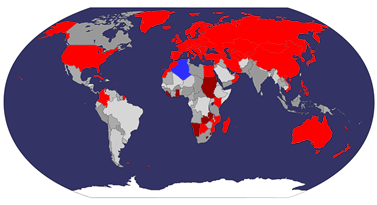
The updated worldwide Madrid Protocol situation, from 10 December 2012, will look something like this.

Madrid Protocol World Coverage
Svalbard Spain United States of America Antarctica South Georgia Falkland Islands Bolivia Peru Ecuador Colombia Venezuela Guyana Suriname French Guiana Brazil Paraguay Uruguay Argentina Chile Greenland Canada United States of America United States of America Israel Jordan Cyprus Qatar United Arab Emirates Oman Yemen Saudia Arabia Iraq Afghanistan Turkmenistan Iran Syria Singapore China Mongolia Papua New Guinea Brunei Indonesia Malaysia Malaysia Tiawan Philippines Vietnam Cambodia Laos Thailand Burma Bangladesh Sri Lanka India Bhutan Nepal Pakistan Afghanistan Turkmenistan Tajikistan Kyrgyzstan Uzbekistan Japan North Korea South Korea Russia Kazakhstan Russia Montenegro Portugal Azerbaijan Armenia Georgia Ukraine Moldova Belarus Romania Bulgaria Macedonia Serbia Bosonia & Herzegovina Turkey Greece Albania Croatia Hungary Slovakia Slovenia Malta Spain Portugal Spain France Italy Italy Austria Switzerland Belgium France Ireland United Kingdom Norway Sweden Finland Estonia Latvia Lithuania Russia Poland Czech Republic Germany Denmark The Netherlands Iceland El Salvador Guatemala Panama Costa Rica Nicaragua Honduras Belize Mexico Trinidad & Tobago Puerto Rico Dominican Republic Haiti Jamaica The Bahamas Cuba Vanuatu Australia Solomon Islands Fiji New Caledonia New Zealand Eritrea Ethiopia Djibouti Somalia Kenya Uganda Tanzania Rwanda Burundi Madagascar Namibia Botswana South Africa Lesotho Swaziland Zimbabwe Mozambique Malawi Zambia Angola Democratic Repbulic of Congo Republic of Congo Gabon Equatorial Guinea Central African Republic Cameroon Nigeria Togo Ghana Burkina Fassu Cote d'Ivoire Liberia Sierra Leone Guinea Guinea Bissau The Gambia Senegal Mali Mauritania Niger Western Sahara Sudan Chad Egypt Libya Tunisia Morocco Algeria
Map includes Kosovo and South Sudan (as parts of Serbia and Sudan respectively) but these are not covered by the Madrid Protocol
 Member State 
 Madrid Agreement only member 
 Questionable enforceability 

16 December 2011

Protocol progress

Will 2012 see the membership of the Madrid Protocol increase?

Where do you see new members coming from, if at all?

In the words of Elvis Presley, "a little less conversation, a bit more action please" could be in order and I think the last few years have brought many false dawns. Political factors, economic factors and the clout of local legal professionals (when the majority are against membership) put barriers to membership. I say barriers as it's clear we see these as barriers from Europe and the US but I have heard the arguments against. The one that suggests, "the Protocol is a great way of reducing the trade mark spend of large primarily US and European trade mark owners but what benefits does it bring to small local applicants in emerging markets and the developing world?" is prominent, and we do need to guard against arrogance in this respect.

I'll wager that 2012 will see two new members of the Protocol. There might be the addition of a Common Law African country, but don't count on the amendment of the local law to make an International Registration enforceable. I can get a bit annoyed when WIPO secure a new membership but don't follow up vigorously on the adaptation of the local law to accommodate it. It's like receiving a signed cheque when the account has no money in it, or take it the other way, like saying get this amazing Madrid Protocol software when you don't have the hardware to run it.

Anyway, I will even goes as far as saying that the two new members will be Colombia and New Zealand. I don't think I've really put my head on the block here as legal developments in Colombia and New Zealand point towards this.

When WIPO made Spanish an official language of the Madrid Protocol it was expected to facilitate waves of membership from Latin America. This hasn't happen but Colombian membership will bring a sigh of relief from Geneva.

New Zealand is a logical extension. It's legislation is in order, they'll benchmark with countries with similar laws (Australia, Singapore, United Kingdom) and their IPO is very organised so the 18-month examination timeline is no problem. New Zealand IP firms may feel a decline in filings, but Australian IP firms have been filing direct in New Zealand for a few years now due to bilateral arrangements and I think it is an outward looking profession that will adapt, despite some natural reservations.

India and South Africa represent possible future membership but I believe most of us would not want them to rush things. They generally see the benefits and the legislative amendments required should not prove problematic. However, backlogs in the examination of applications should be addressed before they commit to membership. India has made significant progress but I feel some consolidation would be sensible.

I think it's difficult to see much action from Latin America aside from Colombia. I'd anticipate other possible members coming from North Africa. Algeria, the final sole member of the Madrid Agreement may bring some sadness to European quarters as it will bring the curtain down on the Madrid Agreement. Tunisia, a former member of the Madrid Agreement in years gone by may also be ripe for membership.

We shall see and we wait with baited breath.

On another point, as the Madrid Protocol can feel highly politicised at times, you may wish to keep an eye out on International Registration No. 1090797 filed on 10 August 2011 designating, amongst others, Iran and Syria.  Office of origin: Israel...